
7 Schluchten hiking trail

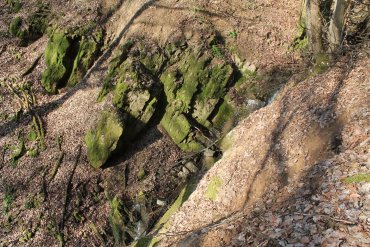
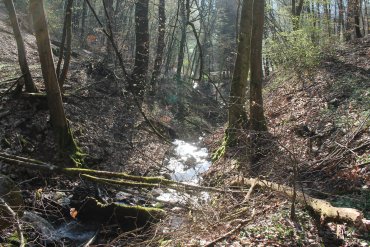
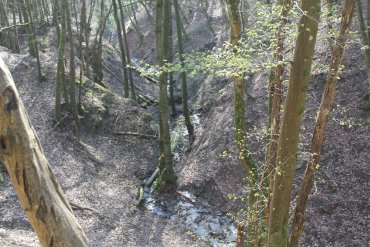
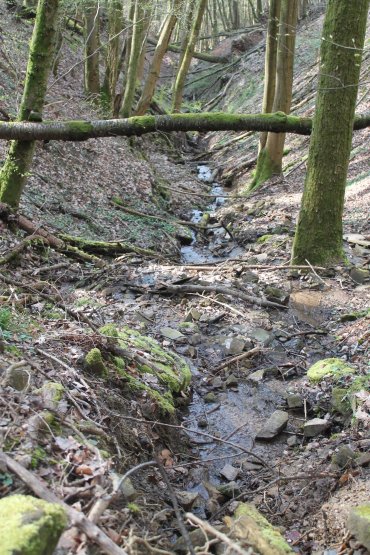
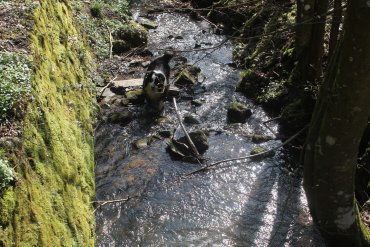
The 7 Schluchten hiking trail is a challenging circular hiking trail that takes you past seven beautiful gorges on an 8 km route.
Uphill and downhill, you will experience an unexpected landscape that has been left untouched and unchanged.
In total, there are around 310 meters of altitude to conquer. The challenging trail consists largely of natural paths, which require a certain level of fitness and, above all, suitable footwear.
You should allow approximately 3.5 hours for the entire route.
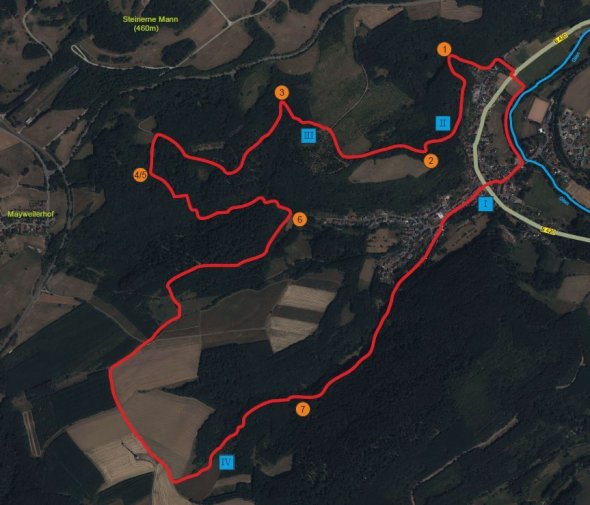
The starting point is the village center with the place name
„ Dorfbrigg“
crossing the B420 into Mühlweg in the direction of the playground with the adjacent Glan bridge, behind which is the old Erdesbach mill with the weir and the fish ladder / fish ladder newly built in 2013. (I)
Before the Glan bridge, continue along the left bank of the river until you reach the B420 again, which you have to cross in the direction of the cemetery and then uphill to the "Kimmelingschlucht" (1).
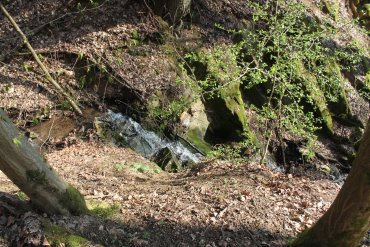
Above a small waterfall, change sides of the stream and then the path leads past the former last vineyard (II) through the "Rummelswald" to the "Rellergrawe" (2).
After passing this, the trail continues steeply uphill on the Veldenz hiking trail and then left to the "Kohllochschlucht" (3). Info Landesfosten / seed culture (III).
Now follow a forest path and turn left at the "Buhlwiese" into a sloping meadow path in the area of two spring streams of the Wingertbach (4).
Especially in spring, the "Bärlauchschlucht" (5) can be described as unique for our region.
The trail now climbs steeply uphill to the right before the village with a constant view into the gorge of the further source stream of the Wingertbach / former mill. (6)
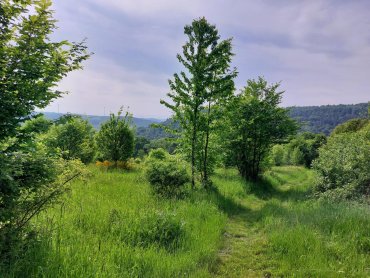
At the end of this passage, the path runs to the left through a small valley until you reach the Staffelweg at the end. Now continue uphill to the right until you reach the first wind turbine. You have now reached the highest point of the hike. The open terrain offers a magnificent view over the middle Glan valley and its mountains. Info on the state forests / sequoia trees (IV).
Downhill to the left, you now reach the two-parted "Gölschbachschlucht" , former water supply (7) and past the landscape pond in the direction of the village center back to the starting point in the village center.
1. The last vineyard
in Erdesbach was here on the Kranz and not, as mistakenly assumed, on the Wingertsberg.
The very elderly Franz Drumm (*1855) had to give up his vineyard during the Second World War.The sheltered southern exposure was a very good location for the vines planted there. The woodland only came later.
2. The Kimmelingschlucht
is the boundary between Erdesbach and Ulmet. More precisely, the gorge with the small waterfall separates the Erdesbach and Ulmet Rummelswald forests.
According to an old legend, the Erdesbach councillors had to cede what is now part of Ulmet to the Ulmet municipality to pay off drinking debts.
Unfortunately there is no literature on this.
3. In Rellergrawe or also named Kottengrawe
a small settlement for lepers is mentioned in the 19th century.
People with infectious diseases, who were no longer allowed to stay in the village, had to eke out a miserable existence here in primitive cards = cottages.
The upper part of the ravine is known as Wolfsgrawe.
Wolves were not uncommon here in the 17th and 18th centuries.
4. The Kohllochschlucht
is the name of this gorge. According to oral tradition, coal was mined here in a thin seam. However, it is also conceivable that the name "Kohlloch" is due to the extraction of charcoal.
Unfortunately, neither theory has been proven.
5. The Bärlauchschlucht
is a unique phenomenon in our region from March onwards.
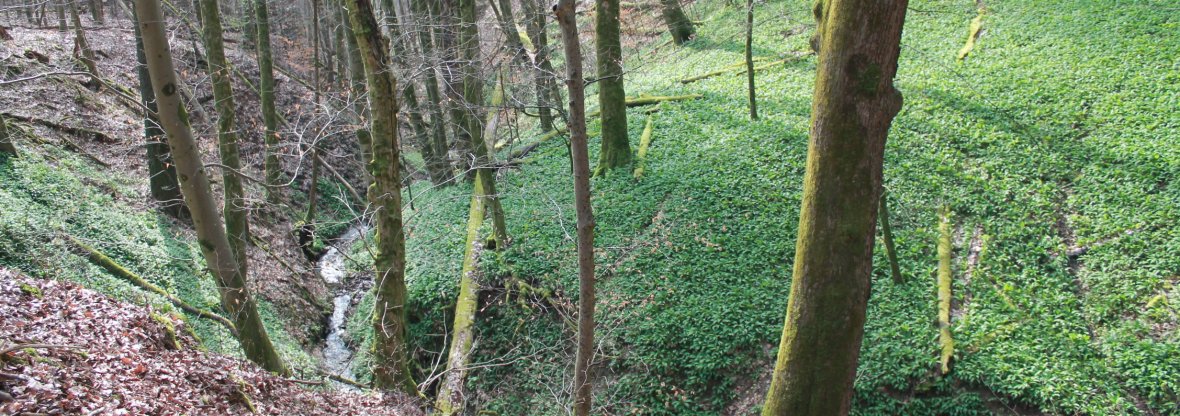
Irgendwann gelangte der Bärlauchsamen in die Schlucht und fand hier wohl ideale Wachstumsvoraussetzungen.
The abundant presence of wild garlic plants on the steep slopes of the gorge causes a large part of the deep gorge to turn green even before the leaves sprout in the forest.
Wild Garlic
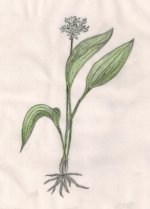
Wild garlic belongs to the plant genus Allium, is related to onions, chives and garlic and is one of around 700 species in this genus.
Use in the kitchen
Wild garlic is completely edible as a vegetable, spice and medicinal plant. If you don't have it in your own garden and have to rely on wild collection, there are a few things you should bear in mind:
Wild garlic leaves can be confused with the poisonous leaves of lily of the valley and the highly poisonous autumn crocus. However, these do not smell of garlic and the leaves are not stalked.
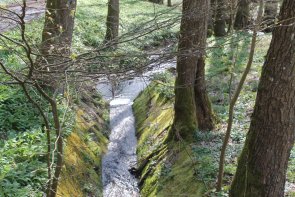
6. The Wingertsbach
and its small tributaries have since become rivulets.
In the middle of the 19th century, the dammed water fed the overshot mill wheel of a communal corn mill. For competitive reasons, the owner of the Patersbach mill bought the small mill and had it completely demolished.
Today's water shortage would make running the mill impossible.
7. The Erdesbach water supply
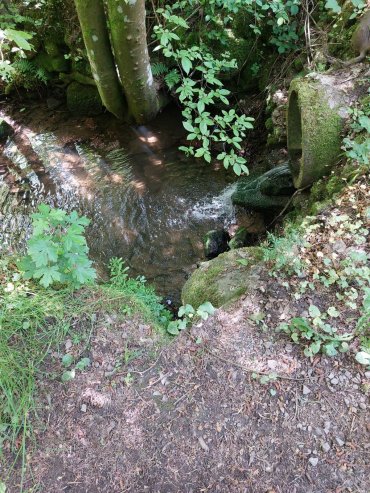
Until the mid-60s of the last century, Erdesbach was supplied by a total of 4 wells in the Gölschbach gorge. The water was fed into a reservoir with a capacity of 60 cubic meters and supplied to the mains from the pump house. The last water master, Ludwig Kunz, had his hands full maintaining the system. In summer, there was barely enough water anyway. Times changed, toilets replaced the outhouses, households were equipped with bathrooms and washing machines were installed. Saturdays were bathing days and those who bathed early were lucky, those who were late remained dirty until the following week. The water shortage had to be alleviated with the tanker until the connection to the Ohmbachverband.