

The Way of St. James
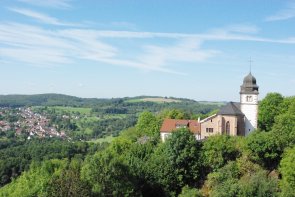

This stage takes us from Remigiusberg in Haschbach through Kusel up to Lichtenberg Castle and via the Fritz Wunderlich Trail to the viaduct in Freisen-Oberkirchen.
The Remigiusberg between Altenglan and Theisbergstegen with its castle ruins and church is the focal point of the Glan Valley landscape. Separated by a mountain cut, the ruins of Michelsburg Castle rise on the Remigiusberg to the east opposite the church.
Remigius Church was once the religious center of the Benedictine provostry of St. Remigi Remigiusberg, a branch monastery of St. Remy Abbey near Reims, which was first mentioned in documents in 1127.
"A small town lies in the Palatinate countryside, in a valley so beautiful..." This is how the famous son of the town of Kusel Fritz Wunderlich sings about his Kusel. A tour of Fritz Wunderlich's hometown of Kusel takes us to places where he lived and worked, to places of remembrance. He is remembered in the memorial rooms of the town and local history museum in Kusel.
Other sights in Kusel: town hall with carillon, interesting market square with Protestant town church and hatter's fountain,
Catholic church in neo-Gothic style (built between 1886 and 1889), historic town center.
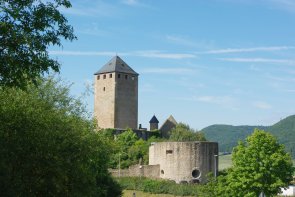
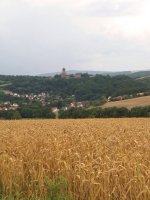
Every visitor is amazed by the beauty of Lichtenberg Castle in the heart of the Palatinate Highlands. It is one of the largest castle ruins in Germany, with a length of 425 m. It was never destroyed by the enemy, but was ravaged by fire around 200 years ago.
The origins of the castle, which was built by the Counts of Veldenz and the Dukes of Palatinate-Zweibrücken, date back to the year 1200. There is a modern youth hostel, a restaurant and three museums within the castle grounds.
At the train station in Schwarzerden you will find the Ostertalbahn, an impressive tourist attraction. The railroad is operated on the route between Schwarzerden and Ottweiler by the Ostertalbahn e.V. working group in the summer months, usually at weekends.
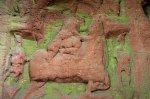
The Mithras monument at the pond in Schwarzerden with its carved relief, which was once the back wall of a temple, is one of the oldest places of worship in our homeland. It is a monument to the Romans' former stay at this site, which probably dates back to the 3rd century AD. The Protestant church in Schwarzerden was completed in 1955. At that time, the church only had a small bell above the entrance. In 2004, a separate bell tower with 2 bells was added, which were cast in Passau.
The Weiselberg nature reserve is rich in natural beauty and impressive treasures. The Weiselberg is famous for the colorful mineral formation of the agates found there. The Mineralogical Museum in Oberkirchen and the Mineral Museum in Freisen exhibit some of the finds.
The most impressive structure in the municipality of Freisen is the viaduct in Oberkirchen. Its 12 arches on 11 pillars extend over 275 m and span the Oster valley at a height of 30 m directly at the entrance to Oberkirchen. The viaduct is one of the largest stone bridges in southwest Germany. It is assumed that the Catholic church of St. Katharina Oberkirchen dates back to the 14th or 15th century. The church shows itself in all its glory as the Christian and cultural center of Oberkirchen.
The valley bridge is the end point of this stage. The Way of St. James then continues for 15.3 km to St. Wendel, on the stage Talbrücke Freisen-Oberkirchen to St. Wendel.4
Further Informations can be found here: Way of St. James